TABLE OF CONTENTS
CHAPTER ONE: INTRODUCTION &
BUSINESS OVERVIEW
1.1 Background of the Study
1.2 Overview of the Coconut Industry in Nigeria
1.3 Rationale for Coconut Oil & Derivatives Production
1.4 Business Concept and Value Proposition
1.5 Vision Statement
1.6 Mission Statement
1.7 Core Values
1.8 Business Objectives (Short, Medium & Long-Term)
1.9 Product Overview
1.10 Legal Structure of the Business
1.11 Scope of Operations
1.12 Business Location and Justification
CHAPTER TWO: COMPANY DESCRIPTION
& BUSINESS ENVIRONMENT ANALYSIS
2.1 Company Profile
2.2 Business Model Description
2.3 Nature of the Business
2.4 Industry Analysis
2.5 Market Structure and Industry Dynamics
2.6 Regulatory Framework in Nigeria
2.7 Government Policies and Incentives
2.8 Environmental and Social Considerations
2.9 PESTLE Analysis
2.10 SWOT Analysis
2.11 Competitive Landscape
2.12 Critical Success Factors
CHAPTER THREE: MARKET ANALYSIS &
MARKETING STRATEGY
3.1 Introduction to Market Analysis
3.2 Global Coconut Oil & Derivatives Market Overview
3.3 Nigerian Coconut Market Overview
3.4 Market Segmentation
3.5 Target Market
3.6 Demand Analysis and Forecast
3.7 Competitive Analysis
3.8 Pricing Strategy
3.9 Marketing Strategy
3.9.1 Product Strategy
3.9.2 Branding Strategy
3.9.3 Promotion Strategy
3.9.4 Distribution Strategy
3.10 Sales Strategy
3.11 Customer Retention Strategy
3.12 Market Entry Strategy
3.13 Sales Forecast
CHAPTER FOUR: TECHNICAL &
PRODUCTION PLAN
4.1 Introduction
4.2 Plant Location and Site Selection
4.3 Production Capacity and Scale
4.4 Raw Material Sourcing and Supply Chain
4.5 Production Process Flow
4.5.1 Virgin Coconut Oil Production
4.5.2 Refined Coconut Oil Production
4.5.3 Coconut Cake and Meal Production
4.5.4 Coconut Shell Charcoal Production
4.5.5 Coconut Coir Fiber Production
4.6 Machinery and Equipment
4.7 Quality Control and Quality Assurance
4.8 Packaging and Storage
4.9 Utilities and Infrastructure
4.10 Environmental and Safety Management
4.11 Production Schedule
4.12 Technology Partnership and Upgrade Plan
4.13 Capacity Expansion Plan
CHAPTER FIVE: ORGANIZATIONAL
STRUCTURE & MANAGEMENT PLAN
5.1 Introduction
5.2 Governance Structure
5.3 Management Team Profile
5.4 Organizational Structure (Organogram)
5.5 Staffing Requirements and Manpower Plan
5.6 Human Resource Policies
5.7 Training and Capacity Development
5.8 Performance Management System
5.9 Compensation and Welfare
5.10 Health, Safety and Industrial Relations
5.11 Succession Planning and Talent Management
5.12 Organizational Culture
CHAPTER SIX: FINANCIAL PLAN
6.1 Introduction to Financial Plan
6.2 Key Financial Assumptions
6.3 Startup Cost Analysis
6.3.1 Land and Site Development
6.3.2 Buildings and Civil Works
6.3.3 Machinery and Equipment (CAPEX)
6.3.4 Pre-Operational Expenses
6.3.5 Working Capital Requirement
6.4 Sources of Finance
6.5 Operating Expenditure (OPEX)
6.6 Revenue Projections
6.7 Profit and Loss Projection (5 Years)
6.8 Cash Flow Projection
6.9 Break-Even Analysis
6.10 Financial Ratios Analysis
6.11 Sensitivity Analysis
6.12 Taxation and Incentives
6.13 Financial Risk Management
CHAPTER SEVEN: RISK ANALYSIS,
SUSTAINABILITY STRATEGY & EXIT STRATEGY
7.1 Introduction
7.2 Risk Identification and Analysis
7.3 Risk Mitigation Strategies
7.4 Risk Matrix
7.5 Sustainability Strategy
7.5.1 Environmental Sustainability
7.5.2 Social Sustainability
7.5.3 Economic Sustainability
7.5.4 ESG Commitments
7.6 Long-Term Growth Strategy
7.7 Exit Strategy Options
7.8 Investor Return Expectations
7.9 Contingency and Business Continuity Plan
7.10 Conclusion
CHAPTER EIGHT: IMPLEMENTATION PLAN
& MILESTONES
8.1 Project Implementation Timeline
8.2 Key Milestones
8.3 Monitoring and Evaluation Framework
CHAPTER NINE: APPENDICES
9.1 Detailed Financial Statements
9.2 Equipment Specifications
9.3 Sample Product Packaging Designs
9.4 Quality Control Checklists
9.5 Operational Policies and SOPs
9.6 Regulatory Approval List
9.7 Risk Management Templates
9.8 Organizational Job Descriptions
1.0 EXECUTIVE SUMMARY
1.1 Business Overview
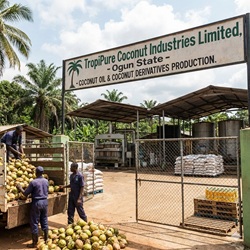
TropiPure
Coconut Industries Limited is a proposed agro-processing and manufacturing company focused on the
large-scale processing of coconuts into virgin coconut oil (VCO), refined
coconut oil (RBD), coconut cake/meal, coconut flakes, coconut shell charcoal,
and coconut-based cosmetic inputs. The business will be located in South-West
Nigeria, strategically positioned close to coconut-growing belts in Ogun,
Lagos, Ondo, and Osun States, while maintaining strong market access to
Lagos—the commercial hub of Nigeria.
The
company aims to address Nigeria’s growing demand for healthy edible oils,
natural cosmetics ingredients, industrial oils, and export-grade coconut
derivatives, while reducing dependence on imported vegetable oils and
cosmetic raw materials.
1.2 Products and Value Proposition
TropiPure
Coconut Industries Limited will operate a multi-product coconut processing
facility, ensuring maximum utilization of each coconut fruit and minimal
waste.
Primary Products
1. Virgin
Coconut Oil (VCO) –
Cold-pressed, food-grade and cosmetic-grade
2. Refined
Coconut Oil (RBD) – For
food processing, soap, and industrial use
Secondary & By-products
3. Coconut
Cake/Meal – Animal
feed and baking ingredient
4. Coconut
Flakes & Desiccated Coconut – Food and confectionery markets
5. Coconut
Shell Charcoal – BBQ
fuel and activated carbon feedstock
6. Coconut
Husk Fiber (Coir) –
Bedding, erosion control, and horticulture
7. Coconut-Based
Cosmetic Inputs – Oils
for creams, soaps, lotions, and hair products
Unique
Value Proposition
- 100% natural, chemical-free
processing
- Zero-waste production model
- Competitive pricing versus
imported alternatives
- Strong export potential due
to rising global demand for coconut derivatives
1.3 Market Opportunity
Nigeria
consumes over 2 million metric tons of vegetable oils annually, yet local
production remains insufficient. At the same time, consumer awareness of healthy
oils, organic skincare products, and plant-based ingredients is rising
rapidly.
Key
demand drivers include:
- Growing middle class seeking
healthier cooking oils
- Expansion of Nigeria’s
cosmetics and personal care industry
- Rising demand for coconut
oil in pharmaceuticals and nutraceuticals
- Strong export demand from
Europe, North America, and Asia
Currently,
over 70% of coconut oil and derivatives used in Nigeria are imported,
creating a significant opportunity for import substitution and export earnings.
1.4 Target Markets
Domestic Market
- Households (retail coconut
oil)
- Food processors and bakeries
- Cosmetic manufacturers
- Pharmaceutical companies
- Soap and detergent
manufacturers
- Livestock feed producers
Export Market
- Europe (organic and
cosmetic-grade oils)
- Middle East (food-grade
oils)
- Asia (industrial coconut
derivatives)
- West African sub-region
(ECOWAS)
1.5 Location Strategy
The
proposed processing facility will be situated in Ogun State, close to:
- Major coconut farming
clusters
- Lagos consumption and export
channels
- Expressways linking ports
(Apapa, Tin Can, Lekki Deep Sea Port)
This
location offers:
- Lower land and labor costs
than Lagos
- Access to skilled and
semi-skilled manpower
- Favorable state industrial
policies
1.6 Production Capacity (Phase 1)
- Coconut Processing Capacity: 40,000–60,000 coconuts per
day
- Virgin Coconut Oil Output: 6–8 tons/day
- Refined Coconut Oil Output: 8–10 tons/day
- By-products: 100% utilization of shells,
husks, and cake
Production
will operate on two shifts daily, scalable to three shifts by Year 3.
1.7 Competitive Advantage
TropiPure
Coconut Industries Limited will compete effectively through:
- Direct sourcing from farmers
via out-grower schemes
- Integrated processing (oil +
derivatives)
- Lower production cost
through waste monetization
- Compliance with NAFDAC, SON,
and export standards
- Strong branding focused on
purity, health, and sustainability
1.8 Financial Highlights (Summary)
- Estimated Startup Capital: ₦1.8bn – ₦2.7bn
- Projected Annual Revenue
(Year 1):
₦3.5bn – ₦5.2bn
- Net Profit Margin: 25–35%
- Break-even Period: 18–24 months
- ROI (Year 2 onward): 35–50%
1.9 Sustainability & Social Impact
The
business is built on a circular economy model, ensuring:
- Zero waste through husk,
shell, and cake utilization
- Renewable energy from
coconut shell charcoal and biomass
- Direct income support for
over 800 coconut farmers
- Employment for 120+ staff
(direct and indirect)
1.10 Vision, Mission & Objectives
Vision:
To become Nigeria’s leading producer of premium coconut oil and coconut
derivatives for domestic and global markets.
Mission:
To process coconuts sustainably into high-quality, natural products that
promote health, create jobs, and drive export growth.
Core
Objectives:
- Achieve SON and NAFDAC
certification in Year 1
- Commence export within 24
months
- Expand into activated carbon
and cosmetic formulations by Year 4
- Establish a national coconut
farmer network
2.0 COMPANY
DESCRIPTION & BUSINESS ENVIRONMENT ANALYSIS
2.1 COMPANY PROFILE
2.1.1 Business Name
TropiPure Coconut Industries Limited
(The name is flexible and can be
modified.)
2.1.2 Legal Status
TropiPure Coconut Industries Limited will be
registered as a private limited liability company under the Companies
and Allied Matters Act (CAMA), Nigeria.
The company will operate with:
· Corporate Affairs Commission
(CAC) registration
· NAFDAC approval (food &
cosmetic-grade oils)
· Standards Organisation of Nigeria
(SON) certification
· Nigerian Export Promotion Council
(NEPC) registration
· Ogun State Ministry of Commerce
& Industry approvals
2.1.3 Business Address (Proposed)
Factory Location:
Agro-Processing Industrial Layout,
Sagamu–Ijebu Ode Axis,
Ogun State, Nigeria.
Head Office:
Lagos–Abeokuta Expressway Corridor,
Lagos State (Sales & Export Coordination).
2.1.4 Nature of Business
TropiPure Coconut Industries Limited is an integrated
agro-processing and manufacturing enterprise involved in:
· Processing raw coconuts into
edible, cosmetic, and industrial products
· Manufacturing virgin and refined
coconut oil
· Producing coconut-based food
ingredients and industrial by-products
· Supplying both domestic and
export markets
The business adopts a vertical
integration model, covering sourcing, processing, packaging, branding,
and distribution.
2.2 BUSINESS MODEL
2.2.1 Integrated Value Chain Model
The company operates across the following
value chain stages:
1.
Raw Coconut Procurement
o
Direct farmer sourcing
o
Out-grower schemes
o
Aggregator partnerships
2.
Primary Processing
o
Dehusking
o
Deshelling
o
Kernel extraction
3.
Secondary Processing
o
Cold pressing (VCO)
o
Hot pressing and refining (RBD oil)
4.
By-product Conversion
o
Coconut cake → animal feed & baking flour
o
Coconut shell → charcoal & activated carbon feedstock
o
Coconut husk → coir fiber
5.
Packaging & Branding
o
Retail bottles (250ml–1L)
o
Bulk containers (20L–200L)
o
Export drums & flexitanks
6.
Distribution
o
Direct B2B supply
o
Distributors & wholesalers
o
Export agents
2.2.2 Revenue Streams
TropiPure Coconut Industries Limited
generates revenue from:
· Virgin Coconut Oil (VCO) –
premium pricing
· Refined Coconut Oil –
volume-driven
· Coconut flakes & desiccated
coconut
· Coconut cake/meal (animal feed)
· Coconut shell charcoal
· Industrial cosmetic oil supply
This diversified revenue base reduces
dependence on a single product.
2.3 OWNERSHIP STRUCTURE
The company will be owned by:
· Founding Promoters – 60–70% equity
· Strategic Investors /
Partners – 20–30%
· Employee Share Incentive
Scheme (ESOP) – 5–10% (optional,
future)
Ownership structure allows flexibility for:
· Private equity investment
· Development finance institution
(DFI) participation
· Future partial divestment or IPO
2.4 VISION, MISSION & CORE
VALUES
Vision
To become Nigeria’s most trusted producer of
premium coconut oil and coconut derivatives for domestic and global markets.
Mission
To process coconuts sustainably into
high-quality, natural products that enhance health, support farmers, and
promote export-driven growth.
Core Values
· Quality Excellence
· Integrity &
Transparency
· Sustainability
· Innovation
· Community Empowerment
2.5 BUSINESS ENVIRONMENT ANALYSIS
2.5.1 Industry Overview
The coconut processing industry in Nigeria is
underdeveloped relative to demand. Nigeria produces over 260,000
metric tons of coconuts annually, yet most are sold raw with minimal
processing.
Key observations:
· Heavy reliance on imported
coconut oil and cosmetic inputs
· Fragmented local processing
capacity
· Rising consumer preference for
natural and organic products
This gap creates strong opportunities for
local processors with modern facilities.
2.6 MACRO-ENVIRONMENT ANALYSIS
(PESTLE)
2.6.1 Political Environment
· Government support for
agro-processing and import substitution
· Export promotion incentives under
NEPC
· AfCFTA enabling regional exports
· Agricultural intervention funds
(BOI, NIRSAL, CBN-linked programs)
Impact: Positive and supportive.
2.6.2 Economic Environment
· High inflation increases food and
cosmetic prices
· Rising foreign exchange cost
favors local manufacturing
· Growing middle-class demand for
premium food oils
· Strong export earnings potential
Impact: Mixed but favorable for local producers.
2.6.3 Social Environment
· Increased awareness of healthy
diets
· Preference for natural skincare
products
· Growing vegan and plant-based
lifestyles
· Youth employment needs favor
agro-industrial ventures
Impact: Strong positive demand drivers.
2.6.4 Technological Environment
· Availability of modern coconut
oil extraction technology
· Improved cold-press and refining
systems
· Local fabrication of auxiliary
equipment
· Digital marketing and e-commerce
growth
Impact: Enhances efficiency and scalability.
2.6.5 Legal & Regulatory
Environment
· NAFDAC approval mandatory for
edible and cosmetic oils
· SON standards regulate product
quality
· Environmental compliance (NESREA,
EIA)
· Export documentation compliance
Impact: Moderate regulatory burden, manageable with
compliance.
2.6.6 Environmental Considerations
· Coconut processing produces
biodegradable waste
· Opportunity for zero-waste and
circular economy models
· Increasing focus on sustainable
manufacturing
Impact: Strong alignment with sustainability goals.
2.7 COMPETITIVE ENVIRONMENT
2.7.1 Industry Structure
· Small-scale processors dominate
rural markets
· Few medium-to-large integrated
processors
· Imported coconut oil brands
control premium segments
2.7.2 Competitive Advantage of
TropiPure
|
Area
|
Advantage
|
|
Scale
|
Larger, consistent production
|
|
Cost
|
Lower raw material cost
|
|
Quality
|
Standardized, certified products
|
|
Integration
|
Multiple product lines
|
|
Branding
|
Health-focused positioning
|
|
Sustainability
|
Zero-waste processing
|
2.8 SWOT ANALYSIS
Strengths
· Access to coconut-growing regions
· Integrated processing model
· Diverse product portfolio
· Strong management structure
Weaknesses
· High initial capital requirement
· Dependence on farmer supply
consistency
Opportunities
· Import substitution
· Export expansion
· Cosmetic industry growth
· Activated carbon production
Threats
· Imported substitutes
· Raw material price volatility
· Regulatory delays
2.9 REGULATORY & COMPLIANCE
REQUIREMENTS
To operate legally, the business will obtain:
· CAC Certificate of Incorporation
· NAFDAC product registration
· SON conformity assessment
· NEPC exporter’s certificate
· Environmental Impact Assessment
(EIA)
· Ogun State factory permit
Compliance ensures credibility, export
eligibility, and investor confidence.
2.10 STRATEGIC GOALS (FIRST 5 YEARS)
1.
Achieve full operational capacity within 12 months
2.
Secure long-term supply contracts with 1,000+ farmers
3.
Launch branded retail coconut oil nationwide
4.
Begin export by Year 2
5.
Introduce activated carbon and cosmetic formulations by Year 4
Click “DOWNLOAD NOW” below to get the complete Business Plan
FOR QUICK HELP CHAT WITH US NOW!
+(234) 0814 780 1594



Login To Comment