TABLE
OF CONTENTS
1.0 EXECUTIVE SUMMARY
1.1. Introduction
1.2. The Business Opportunity
1.3. Key Products
1.4. Mission Statement
1.5. Vision Statement
1.6. Core Values
1.7. Business Model
1.8. Competitive Advantage
1.9. Market Outlook
1.10. Financial Highlights (Projected)
1.11. Management & Staffing Highlights
1.12. Expansion Roadmap
2.0 COMPANY OVERVIEW
2.1. Introduction to the
Company
2.2. Company History and
Rationale
2.3. Legal Structure and
Ownership
2.4. Vision and Mission
2.5. Company Goals and
Objectives
2.6. Location and Strategic
Advantage
2.7. Description of
Products and Technology
2.8. Ownership &
Management Philosophy
2.9. Corporate Governance
2.10. Business Philosophy and Core
Competencies
2.11. Regulatory and
Compliance
3.0 MARKET OVERVIEW
3.1 Global Lubricants & Grease Market Overview
3.2 African Market Trends
3.3 Nigerian Lubricants Market Overview
3.4 Lagos State Market Dynamics
3.5 Market Size & Demand Forecast (2025–2030)
3.6 Key Success Factors
3.7 Key Challenges & Barriers to Entry
3.8 SWOT Analysis
4.0 MARKETING & SALES STRATEGY
4.0 Marketing Plan Overview
4.1 Market Segmentation
4.2 Target Market
4.3 Branding Strategy
4.4 Product Strategy
4.5 Pricing Strategy
4.6 Distribution Strategy
4.7 Promotion Strategy
4.8 Competitive Positioning
4.9 Sales Forecast (First 3 Years)
4.10 Marketing Objectives (Year 1–3)
5.0 FINANCIAL PLAN OVERVIEW
5.1 Startup Capital
Requirement
5.2 Production Cost Analysis (Cost of Goods
Sold)
5.3 Monthly & Annual Revenue Forecast (5
Years)
5.4 Operating Expenses
(OPEX)
5.5 Net Profit Before Tax
(5-Year Projection)
5.6 Break-Even Analysis
5.7 Cash Flow Projection
(Year 1 Summary)
5.8 Profitability Ratios
5.9 Sensitivity Analysis
5.10 Financial Feasibility
Summary
APPENDICES
APPENDIX 1: Proposed Factory Layout Design
APPENDIX 2: Sample Packaging & Label
Design Concepts
APPENDIX 3: Key Operational Policies
APPENDIX 4: Standard Operating Procedures
(Sop Templates)
APPENDIX 5: Document
Templates
APPENDIX 6: Legal & Regulatory
APPENDIX 7: Organogram
APPENDIX 8: Business Implementation Timeline
(6 Months)
APPENDIX 9: Marketing Materials
1.0 EXECUTIVE SUMMARY
Business
Name: PrimeLube
Industries Ltd.
Location: Kirirkiri Industrial Zone, Amuwo-Odofin LGA, Lagos State
Proposed Startup Capital: ₦150 million – ₦220 million
(Small/Medium-Scale Plant)
Product Line: Automotive Lubricants, Industrial Lubricants, Marine
Lubricants, Grease Products, Specialty Oils
1.1. Introduction
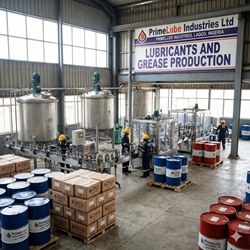
PrimeLube Industries Ltd. is a proposed
small-to-medium scale lubricant and grease production company to be established
in the Kirikiri Industrial Layout of Lagos State—one of Nigeria’s most
strategically positioned industrial clusters with close access to the Apapa
Port, major highways, petrochemical suppliers, and thousands of downstream
lubricant distributors. The company aims to manufacture high-quality automotive
and industrial lubricants, including engine oils, hydraulic oils, gear oils,
transmission fluids, and multipurpose greases tailored to meet the needs of
Nigeria’s rapidly expanding automotive, industrial, and logistics sectors.
Nigeria’s lubricant market is one of the largest in
sub-Saharan Africa, valued at an estimated ₦1.3 trillion annually,
driven by increasing vehicle ownership, manufacturing expansion, construction
growth, logistics intensification, and the booming energy sector. Despite the
presence of large players such as TotalEnergies, Oando, MRS, Conoil, and Mobil,
the lubricant market remains heavily fragmented with over 60% of sales
attributed to independent blenders and SMEs, creating huge opportunities
for innovative producers like PrimeLube Industries Ltd.
PrimeLube’s competitive advantage will come from
its modern blending technology, strict quality assurance aligned with SON,
API, SAE, and ISO standards, flexible production system, and aggressive
distribution model targeting wholesalers, retailers, industrial users,
transport companies, and e-commerce channels.
1.2. The Business Opportunity
Nigeria’s
lubricant industry suffers from three major supply gaps:
1. Inconsistent
product quality from
small-scale blenders
2. High
prices caused
by reliance on imported base oils and additives
3. Poor
branding and packaging which affects consumer confidence
PrimeLube
Industries Ltd. intends to bridge these gaps through:
- Scientific formulation using
approved international additive packages
- Efficient small-scale
blending technology to reduce production cost
- Modern packaging designs
that enhance brand appeal
- Strong distributor
incentives
- Strict quality assurance and
continuous laboratory testing
Furthermore,
the insufficiency of local grease manufacturers creates another huge demand
gap, as Nigeria imports or blends over 50% of all greases consumed,
especially for heavy equipment, industrial machinery, marine vessels, and fleet
operators.
1.3. Key Products
PrimeLube
will produce a range of high-demand lubricants and greases:
Automotive Lubricants
1. Premium
Engine Oil (20W-50, 15W-40, Fully Synthetic 5W-30)
2. Motorcycle
Oil (4T SAE 20W-50)
3. Automatic
Transmission Fluid (ATF DEXRON II & III)
4. Gear Oil
(SAE 90, SAE 140)
Industrial Lubricants
5. Hydraulic
Oil (ISO VG 32, VG 46, VG 68)
6. Compressor
Oils
7. Transformer
Oils (if needed)
Grease Products
8. Lithium-based
multipurpose grease (MPG)
9. Heavy-duty
high-temperature grease (HTG)
10. Calcium-based
grease (affordable option)
Specialty Products
11. Cutting/Metal
Working Fluids
12. Industrial
Circulation Oils
13. Marine
Lubricants
PrimeLube
will begin with the highest-demand products—engine oil (20W-50), hydraulic
oils, gear oils, ATF, and multipurpose lithium grease—before expanding
capacity.
1.4. Mission Statement
“To
manufacture and distribute high-quality, affordable, and performance-proven
lubricants and grease products that enhance engine efficiency, industrial
productivity, and customer satisfaction while contributing to Nigeria’s
industrial development.”
1.5. Vision Statement
“To
become one of Nigeria’s top five SME lubricant producers within five years and
a nationally recognized brand known for reliability, innovation, and superior
value.”
1.6. Core Values
- Quality Assurance
- Innovation
- Integrity and Safety
- Customer-Centric Service
- Operational Excellence
- Environmental Responsibility
1.7. Business Model
PrimeLube
Industries Ltd. will operate a B2B and B2C hybrid model, distributing
through:
B2B Channels
- Distributors and wholesalers
- Filling stations
- Transport and logistics
companies
- Manufacturing companies
- Marine operators
- Government agencies (LGAs,
State operations)
B2C Channels
- Auto spare parts markets
- Motor mechanics
- Car servicing centers
- E-commerce platforms
- Retail outlets
The
company’s revenue model is built on volume sales, distribution partnerships,
and private-label production for smaller brands seeking custom blends.
1.8. Competitive Advantage
1. Proximity
to Apapa Port for
importing base oil and additives at lower transportation cost
2. Flexible
small-scale blending plant with quick turnaround time
3. On-site
mini laboratory for
quality assurance
4. Strong
distribution incentives—discounts, credit lines, profit-sharing
5. Attractive
packaging designs to boost
customer confidence
6. Affordable
pricing due to
efficient overhead management
7. Production
of grease, which
fewer local players manufacture
8. Aggressive
marketing using
social media, mechanics associations, and brand ambassadors
1.9. Market Outlook
Nigeria’s lubricant consumption exceeds 700 million
liters annually, driven by:
- Over 12 million vehicles
on Nigerian roads
- Manufacturing and
construction expansion
- The growth of SMEs and
logistics companies
- High demand for generator
engine oils due to erratic power supply
- Increased marine and
industrial activities in Lagos
Demand is
expected to grow at 5–7% annually, making the business highly scalable.
1.10. Financial Highlights (Projected)
Startup Cost:
- Small-scale blending plant: ₦80m–₦120m
- Grease production line: ₦40m–₦55m
- Laboratory setup: ₦10m–₦18m
- Facility, licensing,
logistics & working capital: ₦30m–₦45m
Estimated Total: ₦150m–₦220m
5-Year Revenue Projection:
- Year 1: ₦220m – ₦280m
- Year 2: ₦350m – ₦420m
- Year 3: ₦480m – ₦600m
- Year 4: ₦650m – ₦800m
- Year 5: ₦900m – ₦1.2bn
Net Profit Margin:
10–18%
from Year 1; expected to hit 25% by Year 5 due to economies of scale.
Break-Even Point:
Estimated
18–22 months depending on sales momentum and plant efficiency.
1.11. Management & Staffing Highlights
PrimeLube
will be managed by professionals with backgrounds in chemical engineering,
petroleum technology, business administration, and quality assurance. The
staffing structure includes:
- Plant Manager
- Production Technicians
- QC/Lab Chemist
- Marketing & Sales Team
- Finance Officer
- Operations & Logistics
Supervisor
- Administrative Staff
This lean
but effective staffing approach maintains efficiency without compromising
quality.
1.12. Expansion Roadmap
Year 1–2:
- Launch core product lines
- Achieve distributor presence
in Lagos, Ogun, Oyo, and Edo
- Establish strong online
presence
- Introduce private-label
production
Year 3–4:
- Expand grease plant
- Launch synthetic oils and
marine lubricants
- Establish regional depots in
Abuja and Port Harcourt
Year 5+:
- Full automation of plant
- Export lubricants to West
African countries
- Become a household brand
Click “DOWNLOAD NOW” below to get the complete Business Plan
FOR QUICK HELP CHAT WITH US NOW!
+(234) 0814 780 1594



Login To Comment