TABLE OF
CONTENTS
1.0 Executive Summary
1.2 Opportunity &
Rationale
1.3 Business model
1.4 Financial snapshot
2.0 Company Overview
2.1 Mission, Vision &
Values
2.2 Legal & Regulatory Considerations
2.3 Location & Site Rationale
2.4 Products & Production Lines
2.5 Target Customers & Channels
2.6 Competitive Advantages)
2.7 Key Risks
3.0 Market Analysis &
Competitive Landscape
3.1 Quick market headline
3.2 Market sizing
3.3 Demand breakdown by end-use
3.4 Competitor mapping
3.5 Pricing benchmarks & suggested pricing strategy
3.6 Go-to-market &
distribution plan
3.7 Competitive / operational risks & mitigation
3.8 Quick go/no-go checklist for sales launch (first 90 days)
4.0 Production Plan &
Technology
4.1. Process Flow Overview (Rubber Contact Adhesive)
4.2. Plant Capacity and Layout
4.3 Equipment List and Approximate CAPEX (₦)
4.4 Raw Material Basket & Unit Cost Estimates
4.5 Labor, Utilities &
Overheads
4.6 5-Year Financial Model
Inputs (Projections)
4.7 Sales & Marketing
Plan (Year 1 Breakdown)
4.8 Key Financial Ratios
4.9 Sensitivity Considerations
5.0 Organizational & Management Structure
5.1 Ownership Structure
5.2 Board of Directors
5.3 Management & Departmental Structure
5.4 Staffing Plan
6.0 Operational Plan
6.1 Production Operations
6.2 Key Suppliers
6.3 Quality Control & SOPs
6.4 Maintenance & HSE
6.5 Implementation Timeline
7.0 Risk Analysis
7.1 Operational Risks
7.2 Market Risks
7.3 Financial Risks
7.4 Regulatory & Environmental Risks
7.5 Business Continuity Plan
8.0 Sustainability & Expansion Strategy
8.1 Economic Sustainability
8.2 Environmental Sustainability
8.3 Social Sustainability
8.4 Governance & Compliance
9.0 Monitoring &
Evaluation (M&E) Plan
9.1 Objective of the M&E System
9.2 Key Performance Indicators (KPIs)
9.3 M&E Tools & Methods
9.4 Feedback & Adaptive Management
10.0 Conclusion
11.0 Appendices
11.1 Summary Financial Assumptions
11.2 Projected Profit & Loss (₦ Millions)
11.3 Cash Flow Summary (₦ Millions)
11.4 Break-even Analysis
11.5 Key Financial Ratios
11.6 Graphical Summary (Narrative Overview)
1.0 Executive Summary
Business name (suggested): OgunBond Adhesives Limited
Business type: Manufacturer — Rubber-based industrial &
consumer adhesives (solvent-based and water-based formulations)
Location (suggested): Ijaye Industrial Estate, Abeokuta, Ogun
State (close to Lagos market and ports)
Legal form: Private Limited Liability Company (LLC) —
incorporated under the Companies and Allied Matters Act (CAMA)
Planned start date: Q2 2026 (pilot production & licensing),
full commercial production Q4 2026
1.2 Opportunity
& Rationale:
Nigeria’s manufacturing and construction sectors, footwear &
leather, packaging, furniture and general repairs all require reliable adhesive
supplies. Local adhesive demand has historically been met by imports and
small-scale producers that supply inconsistent quality. A mid-scale,
quality-focused rubber-adhesive manufacturer positioned near Lagos but
operating in Ogun State offers lower land/rent costs while keeping access to
major customers and ports. Recent macro moves (currency unification and
inflation corrections) make producing locally more competitive compared to
imported adhesives priced in foreign currency. (Reuters)
1.3 Business model: Produce two production lines initially:
1. Industrial rubber adhesives (high-solids solvent-based
adhesives) for shoe, tire repair, and heavy bonding.
2. Consumer / retail adhesives (tube adhesives, multipurpose
contact adhesives, water-based adhesives) for retailers and wholesalers.
1.4 Financial snapshot (high-level
estimate):
· Estimated startup capital (CAPEX + 6 months OPEX):
₦210 million — ₦320 million (depending on land acquisition vs. lease, level of
automation, and working capital buffer).
· Revenue target (year 1): ₦150M — ₦250M
(conservative, ramping to full capacity in 12 months).
· Breakeven: Expected months 18–30 depending on
market penetration and working capital cycle.
2.0 Company Overview
2.1 Mission, Vision & Values
Mission: To manufacture reliable, high-performance rubber
adhesives that meet industrial standards while lowering reliance on imports,
employing local talent, and maintaining eco-conscious production practices.
Vision: To be West Africa’s leading quality rubber-adhesive
brand within 5 years, trusted by manufacturers, shoemakers, and retailers for
consistent performance and value.
Core values: Quality, Safety, Reliability, Local Empowerment,
Environmental Responsibility
2.2 Legal & Regulatory
Considerations
· Company registration: Incorporation as a
Private Limited Company with CAC (CAMA).
· Regulatory compliance: Chemical handling and
manufacturing permits from Ogun State environmental agency; NAFDAC registration
for consumer adhesive formulations (if formulations are categorized under
consumer chemical products); fire & safety certification from relevant
authorities; compliance with environmental regulations for solvent emissions
and effluent management.
· Standards: Adopt ISO 9001 (quality management)
within 24 months; pursue product-specific quality certifications (as required
by key customers).
2.3 Location & Site Rationale
(Why Ogun State?)
· Industrial cluster & logistics: Ogun State
offers industrial estates and lower land/rent compared to Lagos while keeping
excellent road links to Lagos ports and major markets in the South-West.
Proximity reduces transport for bulky raw materials (solvents, polymers,
fillers) and finished goods distribution to Lagos and Western Nigeria. Market
access advantage vs inland alternatives.
· Land & rent context: Industrial land and
factory-rent costs in Ogun vary widely by estate and size; current market
listings show average industrial land rents and sale prices that make a leased
1,000–2,500 sqm factory plot financially attractive for a medium-scale adhesive
plant. (We used recent listings to estimate site costs in the financial model.)
2.4 Products & Production Lines
(initial)
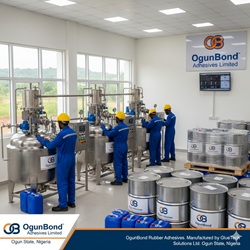
· Rubber Contact Adhesive (solvent-based) — industrial
grade: For footwear, leather, and heavy bonding — sold in 25kg drums
and 200L drums.
· High-Solids Rubber Adhesive for Tire/Repair shops:
Sold to auto workshops and distributors.
· Water-Based Multipurpose Adhesive (tube): For
retail and household use — sold in 50g, 100g tubes.
· Specialty Adhesives (phase 2): Heat-resistant
adhesives and custom formulations for packaging or furniture manufacturers.
2.5 Target Customers & Channels
· B2B: Shoe manufacturers, furniture makers,
packaging firms, automotive repair shops, industrial maintenance contractors.
· B2C / Retail: Hardware stores, supermarkets,
e-commerce marketplaces.
· Distribution channels: Direct sales for large
industrial customers; regional distributors and wholesalers; partnerships with
Lagos-based distributors for FMCG retail penetration.
2.6 Competitive Advantages (planned)
· Local production to reduce foreign-currency exposure and long
shipping lead times. Exchange-rate environment makes import substitution attractive.
· QC-driven production with batch testing and certificates of
analysis.
· Flexible lot sizes (industrial drums to retail tubes) to capture
multiple segments.
· Strategic site in Ogun to lower fixed costs (land/rent) while
keeping Lagos market access.
2.7 Key Risks (high level)
· Volatility in raw material prices (many are
petrochemical-derived); diesel/fuel cost influences captive power generation
cost. Diesel retail averages have been high in 2025 and are a material input
for generator-based power.
· Electricity tariff band exposure: high-use customers may face
elevated band tariffs and unreliable grid supply, so budgeting for reliable
captive generation/solar hybrid is critical.
Click “DOWNLOAD NOW” below to get the complete Business Plan
FOR QUICK HELP CHAT WITH US NOW!
+(234) 0814 780 1594



Login To Comment