TABLE
OF CONTENTS
Title Page
1.0 Executive Summary
2.0
COMPANY DESCRIPTION & BUSINESS ENVIRONMENT ANALYSIS
2.1 Company Overview
2.2 Business Location
2.3 Legal Status & Ownership Structure
2.4 Vision, Mission & Core Values
2.5 Product Description
2.6 Business Model
2.7 Industry Overview – Nigerian Beverage Sector
2.8 Palm Wine Industry Analysis
2.9 Business Environment Analysis
2.9.1 Political & Legal Environment
2.9.2 Economic Environment
2.9.3 Social & Cultural Environment
2.9.4 Technological Environment
2.10 Regulatory & Compliance Requirements
2.11 Competitive Advantage
2.12 SWOT Analysis
3.0
MARKET ANALYSIS & MARKETING STRATEGY
3.1 Introduction
3.2 Market Definition
3.3 Target Market Segmentation
3.3.1 Geographic Segmentation
3.3.2 Demographic Segmentation
3.3.3 Psychographic Segmentation
3.3.4 Institutional & B2B Market
3.4 Market Size & Demand Analysis
3.5 Consumer Buying Behavior
3.6 Pricing Analysis & Strategy
3.7 Competitive Analysis
3.7.1 Direct Competitors
3.7.2 Indirect Competitors
3.8 Marketing Strategy
3.8.1 Product Strategy
3.8.2 Branding Strategy
3.8.3 Promotion Strategy
3.9 Distribution Strategy
3.10 Sales Strategy
3.11 Market Penetration Strategy
3.12 Customer Retention Strategy
3.13 Marketing Budget
3.14 Sales Forecast Assumptions
4.0
TECHNICAL & PRODUCTION PLAN
4.1 Introduction
4.2 Production Process Overview
4.3 Raw Material Sourcing
4.4 Plant Location & Layout
4.5 Production Capacity
4.6 Equipment & Machinery
4.7 Quality Control & Assurance
4.8 Utilities Requirements
4.9 Waste Management & Environmental Control
4.10 Health, Safety & Environment (HSE)
4.11 Production Staffing
4.12 Technology Risk & Mitigation
4.13 Production Cost Drivers
4.14 Process Flow Summary
5.0
ORGANIZATIONAL STRUCTURE & MANAGEMENT PLAN
5.1 Introduction
5.2 Ownership & Governance Structure
5.3 Management Team Structure
5.4 Organizational Structure (Organogram)
5.5 Staffing Plan
5.6 Human Resource Policies
5.7 Performance Management System
5.8 Compensation & Welfare
5.9 Health, Safety & Industrial Relations
5.10 Succession Planning & Talent Development
5.11 Organizational Culture
6.0
FINANCIAL PLAN
6.1 Introduction
6.2 Financial Assumptions
6.3 Startup Cost Estimate
6.4 Capital Expenditure (CAPEX)
6.5 Working Capital Requirement
6.6 Total Project Cost
6.7 Operating Expenditure (OPEX)
6.8 Revenue Projection (5-Year)
6.9 Profit & Loss Summary
6.10 Break-Even Analysis
6.11 Return on Investment (ROI)
6.12 Funding Structure
6.13 Financial Risk & Sensitivity Analysis
7.0 RISK
ANALYSIS, SUSTAINABILITY STRATEGY & EXIT STRATEGY
7.1 Introduction
7.2 Risk Analysis
7.3 Risk Matrix Summary
7.4 Sustainability Strategy
7.4.1 Environmental Sustainability
7.4.2 Social Sustainability
7.4.3 Economic Sustainability
7.5 Corporate Social Responsibility (CSR)
7.6 ESG Commitment
7.7 Exit Strategy
7.8 Exit Timeline
7.9 Long-Term Growth Outlook
7.10 Conclusion
8.0
IMPLEMENTATION PLAN & MILESTONES
8.1 Project Implementation Timeline
8.2 Key Milestones
8.3 Monitoring & Evaluation Framework
9.0
APPENDICES
9.1 Detailed Financial Statements
9.2 Equipment Specifications
9.3 Sample Product Packaging Designs
9.4 Quality Control Checklists
9.5 Operational Policies & Standard Operating Procedures (SOPs)
9.6 Regulatory Approval List
9.7 Risk Management Templates
9.8 Organizational Job Descriptions
1.1 EXECUTIVE SUMMARY
GoldenSap
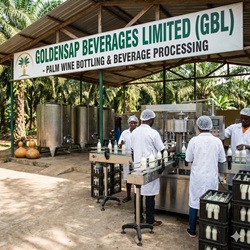
Beverages Limited (GBL) is a proposed palm wine bottling and beverage processing company to be
located in Ogun State, Nigeria. The business is designed to modernize
and commercialize traditional palm wine by applying hygienic processing,
controlled fermentation, pasteurization, and standardized bottling techniques.
Palm wine is one of Nigeria’s most widely consumed indigenous beverages, yet
its commercial potential remains largely untapped due to short shelf life,
inconsistent quality, and lack of formal packaging. GoldenSap Beverages Limited
aims to bridge this gap by producing safe, shelf-stable, and premium palm
wine beverages for local and regional markets.
The company will source fresh palm sap from
organized palm wine tappers and oil palm plantations across Ogun, Ondo, and Oyo
States under structured supply agreements. Using modern beverage-processing
technology, the company will produce a range of products including fresh-style
pasteurized palm wine, lightly fermented palm wine, sparkling palm wine, and
flavored palm wine variants. These products will be packaged in hygienic
glass bottles and PET containers targeting urban consumers, hospitality
businesses, event planners, and export markets within West Africa.
Ogun State offers a strategic location advantage
due to its proximity to Lagos, access to raw materials, availability of
industrial land, and lower operational costs compared to Lagos State. The
proposed facility will be situated within the Sagamu–Ijebu-Ode axis,
enabling efficient distribution to Lagos, Abeokuta, Ibadan, and neighboring
states. The business will operate under full regulatory compliance with NAFDAC,
SON, NESREA, and Ogun State environmental authorities.
The estimated startup capital requirement for the
project is ₦1.2 billion – ₦1.8 billion, covering land acquisition,
factory construction, processing and bottling equipment, working capital, branding,
and regulatory approvals. Financial projections indicate strong revenue growth
driven by increasing demand for indigenous beverages, premium packaging, and
event-based consumption. The company is expected to achieve profitability
within the first two years of operation.
GoldenSap Beverages Limited is committed to
quality, sustainability, and cultural preservation. By combining traditional
knowledge with modern beverage technology, the company seeks to become a
leading brand in Nigeria’s emerging indigenous beverage industry while creating
employment, supporting rural livelihoods, and contributing to agro-industrial
development in Ogun State.
2.0 COMPANY
DESCRIPTION & BUSINESS ENVIRONMENT ANALYSIS
2.1
COMPANY OVERVIEW
GoldenSap Beverages Limited is a proposed indigenous beverage
processing and bottling company to be incorporated under the Companies and
Allied Matters Act (CAMA) of Nigeria as a private limited liability company.
The company will specialize in the hygienic processing, controlled fermentation,
pasteurization, bottling, and distribution of palm wine and palm wine–based
beverages for the Nigerian market and selected West African export
destinations.
The business will combine traditional palm wine tapping
knowledge with modern beverage processing technologies to produce consistent,
safe, and shelf-stable products that meet regulatory standards. GoldenSap
Beverages Limited seeks to reposition palm wine from an informal,
roadside-consumed product to a branded, premium, and widely distributed beverage.
2.2
BUSINESS LOCATION
The
production facility will be located in Ogun State, preferably within the Sagamu–Ijebu-Ode
industrial corridor. This location offers several advantages:
§ Proximity to oil
palm–producing communities
§ Easy access to
Lagos (Nigeria’s largest beverage market)
§ Lower land and
operational costs compared to Lagos State
§ Access to major
highways (Lagos–Ibadan Expressway)
§ Availability of
semi-skilled labor
The factory
will sit on approximately 3–5 hectares of land, accommodating processing halls,
cold storage, bottling lines, warehouses, administrative offices, utilities,
and waste management facilities.
2.3 LEGAL
STATUS & OWNERSHIP STRUCTURE
GoldenSap
Beverages Limited will be owned by a consortium of Nigerian investors with
backgrounds in agribusiness, food processing, distribution, and finance.
Proposed
Ownership Structure
§ Promoter /
Founder – 40%
§ Strategic
Investors – 35%
§ Institutional /
Development Finance – 15%
§ Employee Share
Scheme – 10%
The company
will operate under a formal governance structure with a Board of Directors and
professional management team.
2.4
VISION, MISSION & CORE VALUES
Vision
Statement
To become
Nigeria’s leading producer of premium, hygienic, and culturally authentic palm
wine beverages.
Mission
Statement
To modernize
palm wine processing through technology, quality assurance, and branding while
supporting rural livelihoods and promoting sustainable beverage production.
Core
Values
§ Quality and
safety
§ Cultural
preservation
§ Sustainability
§ Integrity and
transparency
§ Innovation
2.5
PRODUCT DESCRIPTION
GoldenSap
Beverages Limited will produce multiple palm wine beverage variants to serve
diverse consumer segments:
§ Fresh-Style
Pasteurized Palm Wine
§ Lightly
Fermented Palm Wine (Low Alcohol)
§ Sparkling Palm
Wine
§ Flavored Palm
Wine (ginger, pineapple, citrus blends)
§ Premium Event
& Export Bottled Palm Wine
Products
will be packaged in glass bottles (33cl, 50cl, 75cl) and PET bottles with
tamper-proof seals.
2.6
BUSINESS MODEL
The
company will operate an integrated beverage processing model:
§ Contract
sourcing from palm wine tappers
§ Centralized
processing and pasteurization
§ In-house
bottling and labeling
§ Wholesale and
retail distribution
§ Institutional
and event supply contracts
§ Revenue will be
generated through:
§ Direct sales to
distributors
§ Hotel, bar, and
restaurant supply
§ Event-based bulk
orders
§ Export sales
(medium term)
2.7
INDUSTRY OVERVIEW – NIGERIAN BEVERAGE SECTOR
Nigeria’s
beverage industry is one of the largest in Africa, driven by:
§ A population
exceeding 220 million
§ Strong
consumption culture
§ Expanding middle
class
§ Growing demand
for indigenous and natural beverages
While the
alcoholic beverage market is dominated by beer and spirits, traditional
beverages such as palm wine remain under-commercialized, presenting a strong
opportunity for structured entrants.
2.8 PALM
WINE INDUSTRY ANALYSIS
Palm wine is
widely consumed across southern Nigeria, including Ogun State. Despite high
demand, the industry faces challenges such as:
1. Extremely short
shelf life (12–48 hours)
2. Poor hygiene in
informal supply chains
3. Absence of
standard packaging
4. Regulatory
non-compliance
GoldenSap
Beverages Limited addresses these gaps through controlled fermentation,
pasteurization, cold-chain logistics, and branding.
2.9
BUSINESS ENVIRONMENT ANALYSIS
2.9.1
Political & Legal Environment
· Support for agro-processing under Nigerian industrial policies
· Mandatory compliance with NAFDAC, SON, NESREA
· Ogun State investment-friendly policies
2.9.2
Economic Environment
· Rising demand for affordable beverages
· Currency fluctuations affecting imported drinks
· Increased preference for locally produced goods
2.9.3
Social & Cultural Environment
· Strong cultural acceptance of palm wine
· Growing interest in indigenous products among urban youth
· Event and ceremonial consumption
2.9.4
Technological Environment
· Availability of beverage pasteurization equipment
· Bottling automation technologies
· Cold storage and logistics advancements
2.10
REGULATORY & COMPLIANCE REQUIREMENTS
GoldenSap Beverages Limited will obtain and maintain:
· Corporate Affairs Commission (CAC) registration
· NAFDAC product registration
· Standard Organization of Nigeria (SON) certification
· Environmental Impact Assessment (EIA) approval
· Ogun State environmental permits
· Fire safety and factory permits
2.11 COMPETITIVE
ADVANTAGE
· Strong raw material sourcing network
· Shelf-stable palm wine technology
· Premium branding
· Strategic location near Lagos market
· Cultural authenticity combined with quality assurance
2.12 SWOT
ANALYSIS
Strengths
· Abundant raw materials
· Cultural acceptance
· First-mover advantage in organized palm wine bottling
Weaknesses
· Capital-intensive setup
· Need for consumer education
Opportunities
· Untapped formal palm wine market
· Export potential
· Event and hospitality sector growth
Threats
· Informal competitors
· Regulatory delays
· Supply seasonality
Click “DOWNLOAD NOW” below to get the complete Business Plan
FOR QUICK HELP CHAT WITH US NOW!
+(234) 0814 780 1594



Login To Comment