Table of Contents.............................................................................................
1. Business Concept..........................................................................................
2. Proposed Products and Revenue Streams...........................................................
3. Intended Customers.......................................................................................
4. Location and Site Considerations.....................................................................
5. Market Opportunity.......................................................................................
6. Sales and Distribution Approach......................................................................
7. Competitive Position.....................................................................................
8. Commercial Constraints.................................................................................
9. Proposed Production Model............................................................................
10. Feed and Water Management.........................................................................
11. Health and Biosecurity.................................................................................
12. Staffing and Management.............................................................................
13. Basis and Limitations of the Financial Model....................................................
14. Illustrative Start-up Investment Requirement....................................................
15. Year 1 Revenue Forecast..............................................................................
16. Year 1 Projected Income Statement.................................................................
17. Projected Cash Flow....................................................................................
18. Illustrative Projected Balance Sheets...............................................................
19. Break-even Analysis....................................................................................
20. Debt-Service Capacity..................................................................................
21. Sensitivity Analysis.....................................................................................
22. Investment Appraisal...................................................................................
23. Proposed Reporting Structure........................................................................
24. Management Capability Requirements.............................................................
25. Governance and Record Keeping....................................................................
26. Principal Risks and Mitigation.......................................................................
27. SWOT Analysis..........................................................................................
27.1 Strengths.............................................................................................
27.2 Weaknesses.........................................................................................
27.3 Opportunities.......................................................................................
27.4 Threats................................................................................................
28. Conditions Before Finance............................................................................
29. Indicative Implementation Sequence...............................................................
30. First-Year Performance Indicators..................................................................
# 1. Executive Summary
HarvestPoint Agriculture is a proposed
poultry-farming enterprise to be established at Atan, Sango Ota, Ogun State.
The concept is currently at the idea stage and no trading history, customer
contracts, supplier quotations, market survey, production records or confirmed
funding have been supplied. This report therefore assesses the proposal using a
clearly labelled illustrative planning model rather than presenting verified
business performance.
The proposed base case is a commercial
egg-production operation initially managing approximately 1,000 laying birds.
This scale is an illustrative planning assumption adopted because the available
brief identifies the venture only as a poultry farm and does not specify the
production system, flock size, product mix or funding requirement. The
principal product would be table eggs sold through wholesalers, retailers, food
businesses and direct local customers. Poultry manure could provide a secondary
revenue stream. Broiler production, hatchery operations, feed milling and other
poultry activities are not included in the base financial model.
The location offers a potentially suitable
setting for supplying nearby households, food businesses, traders and
institutional buyers in the wider Sango Ota and Ogun State market. However, the
report does not claim that demand has been validated. The commercial case will
depend on HarvestPoint securing reliable buyers, maintaining adequate egg quality,
controlling feed costs, managing disease risk and achieving regular production
at prices sufficient to cover operating costs and debt obligations.
For bank-finance purposes, the proposal is
conditionally viable rather than demonstrably viable. The illustrative model
produces Year 1 revenue of approximately NGN57.3 million and EBITDA of
approximately NGN9.78 million before tax, subject to the assumptions set out in
this report. The illustrative start-up funding requirement is NGN18.0 million,
comprising NGN12.0 million of proposed borrowing and NGN6.0 million of owner
contribution. These are planning figures, not a customer-confirmed loan request
or evidence of secured finance.
Under the base case, monthly operating
break-even is approximately 533 trays of eggs when measured against cash
operating costs before debt service. When first-year interest and principal
repayments are included, the approximate debt-service break-even rises to 769
trays per month, equivalent to approximately NGN4.23 million of monthly egg
sales at the assumed price. The base case assumes sales of about 850 trays per
month. This provides a limited but potentially workable margin above
debt-service break-even. The margin is highly sensitive to egg prices, feed
costs, production interruptions and flock performance.
The principal bankability concern is that the
proposal is supported by an illustrative model rather than verified evidence.
Before lending, the promoter would need to provide a detailed business address
and site-control evidence, supplier quotations, a construction and equipment
budget, evidence of owner equity, a production plan, veterinary and biosecurity
arrangements, buyer-development evidence and a realistic repayment structure.
The lender should also establish whether the proposed collateral, insurance and
guarantees are acceptable.
Subject to those conditions, HarvestPoint
Agriculture may be suitable for further appraisal as a small-scale poultry
enterprise. The recommended decision is not an unconditional approval. A lender
should consider staged or conditional financing only after confirming the
project’s actual capital requirement, the promoter’s contribution, technical
capacity, flock-management arrangements and ability to withstand adverse
feed-price or egg-price movements.
# 2. Business Overview
1. Business Concept
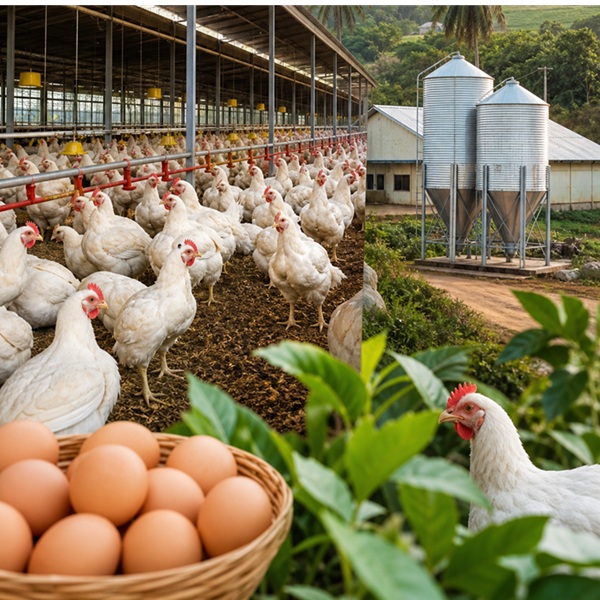
HarvestPoint Agriculture is proposed as a
poultry-farming business located at Atan, Sango Ota, Ogun State. The business
description supplied is “poultry farm”, without further detail on the intended
species, production model or market channel. For the purpose of testing
feasibility, this report develops a defined base case around layer-bird egg
production.
The proposed operating concept is to acquire or
rear laying birds, provide suitable housing, feed and veterinary care, collect
eggs daily, grade and package them, and sell the output to local and regional
buyers. The operation would also collect and sell poultry manure where
practicable. The initial enterprise should remain operationally focused. Adding
broilers, hatchery services, feed production or multiple sites at launch would
increase complexity and should not occur until the first production model is controlled.
The proposed value proposition is based on
availability, consistency and proximity rather than an unverified premium brand
claim. Customers generally require eggs that are available in predictable
quantities, delivered in acceptable condition and supplied at commercially
competitive prices. HarvestPoint’s potential advantage would therefore depend
on reliable production, low breakage, proper hygiene, disciplined record
keeping and responsive delivery.
The business is at the concept stage. Accordingly,
the report distinguishes between:
•
customer-supplied
facts, namely the business name, poultry-farming concept and proposed Ogun
State location;
•
transparent
calculations based on stated model assumptions; and
•
illustrative
planning assumptions introduced because key operating and financial information
was not provided.
The financial currency used in this report is
Nigerian naira, abbreviated as NGN. This is an explicit planning assumption
based on the stated Ogun State location and should be confirmed by the promoter
before submission to a bank.
2. Proposed Products and Revenue Streams
The base case contains two revenue streams.
The primary stream is the sale of table eggs.
For planning purposes, a tray is assumed to contain 30 eggs. The proposed model
assumes 1,000 laying birds, an average laying rate of 85 per cent and 30
production days per month. This produces the following calculation:
1,000 birds × 85 per cent × 30 days = 25,500
eggs per month
25,500 eggs ÷ 30 eggs per tray = 850 trays per
month
The assumed average selling price is NGN5,500
per tray. This is an illustrative planning price only and is not a verified
market quotation. Under the base case:
850 trays × NGN5,500 = NGN4,675,000 monthly egg
revenue
The secondary stream is poultry manure. The base
case includes illustrative manure revenue of NGN100,000 per month, or NGN1.2
million per year. This estimate is particularly uncertain because the quantity,
collection arrangements, buyer demand and achievable price have not been
supplied. The financial model should therefore be tested both with and without
manure income before a credit decision is made.
Possible future products could include spent
layers, broiler meat, pullets or packaged eggs. These are excluded from the
base case because their timing and contribution cannot be calculated safely
from the available information. Revenue from spent birds may arise when the
flock is replaced, but it should not be treated as recurring monthly income.
Click “DOWNLOAD NOW” below to get the complete Feasibility Study
FOR QUICK HELP CHAT WITH US NOW!
+(234) 0814 780 1594
Buyers has the right to create
dispute within seven (7) days of purchase for 100% refund request when
you experience issue with the file received.
Dispute can only be created when
you receive a corrupt file, a wrong file or irregularities in the table of
contents and content of the file you received.
ProjectShelve.com shall either
provide the appropriate file within 48hrs or
send refund excluding your bank transaction charges. Term and
Conditions are applied.
Buyers are expected to confirm
that the material you are paying for is available on our website
ProjectShelve.com and you have selected the right material, you have also gone
through the preliminary pages and it interests you before payment. DO NOT MAKE
BANK PAYMENT IF YOUR TOPIC IS NOT ON THE WEBSITE.
In case of payment for a
material not available on ProjectShelve.com, the management of
ProjectShelve.com has the right to keep your money until you send a topic that
is available on our website within 48 hours.
You cannot change topic after
receiving material of the topic you ordered and paid for.



Login To Comment