TABLE OF CONTENTS
EXECUTIVE SUMMARY
2.0 COMPANY DESCRIPTION
2.1 Company Name
2.2 Registered Business Address
2.3 Nature of Business
2.4 Vision Statement
2.5 Mission Statement
2.6 Core Values
2.7 Key Business Objectives
3.0 BUSINESS ENVIRONMENT ANALYSIS
3.1 Industry Overview
3.2 PESTLE Analysis
3.2.1 Political Factors
3.2.2 Economic Factors
3.2.3 Social Factors
3.2.4 Technological Factors
3.2.5 Legal Factors
3.2.6 Environmental Factors
3.3 SWOT Analysis
3.4 Competitive Analysis
3.5 Value Proposition
3.6 Regulatory Compliance &
Business Permits Required
4.0 MARKET ANALYSIS
4.1 Overview of the Global Cassava
and Ethanol Market
4.1.1 Global Cassava Market
4.1.2 Global Ethanol Market
4.2 Nigerian Market Analysis
4.2.1 Market Demand for Cassava
Chips
4.2.2 Market Demand for Ethanol
4.3 Target Market Segmentation
4.4 Market Size Estimates (Nigeria
and Export)
4.5 Competitive Landscape
4.6 Supply Chain and Value Chain
Analysis
4.7 Marketing Strategy — Overview
5.0 MARKETING STRATEGY
5.1 Product Strategy
5.2 Pricing Strategy
5.3 Distribution Strategy
5.4 Promotion Strategy
5.5 Market Penetration Strategy
5.6 Market Expansion Strategy (3–7
Years)
5.7 Sales Forecast (Summary)
6.0 TECHNICAL & PRODUCTION PLAN
6.1 Plant Location and Justification
6.2 Facilities and Layout Plan
6.3 Production Capacity Planning
6.4 Production Process Flow
6.4.1 Cassava Chips Production
Process
6.4.2 Ethanol Production Process
6.4.3 By-Product Conversion Process
6.5 Machinery and Equipment
Requirements
6.5.1 Cassava Chips Line Machinery
6.5.2 Ethanol Line Machinery
6.5.3 Utilities & Support
Equipment
6.6 Utility Requirements
6.7 Raw Material Procurement Plan
6.8 Packaging and Storage Plan
6.9 Quality Control &
Certification
6.10 Waste Management Plan (Zero
Waste)
6.11 Production Staff and Shift Plan
6.12 Maintenance Plan
6.13 Scalability and Expansion
Strategy
7.0 ORGANIZATIONAL STRUCTURE &
MANAGEMENT PLAN
7.2 Organogram
7.3 Key Management Personnel &
Roles
7.3.1 Managing Director / Chief
Executive Officer (CEO)
7.3.2 Plant / Operations Manager
7.3.3 Finance & Administration
Manager
7.3.4 Commercial Manager (Sales,
Marketing & Export)
7.3.5 Compliance, Safety &
Quality Manager
7.4 Staffing Plan
7.5 Recruitment & Training
Strategy
7.6 Management Information System
(Mis)
7.7 Human Resource Policies
7.8 Management Support Advisory Team
8.0 OVERVIEW OF FINANCIAL MODEL
8.1 Startup Capital Requirement
Summary
8.2 Detailed Capital Expenditure (CAPEX)
8.3 Vehicles & Logistics
8.4 Pre-Production Costs &
Working Capital
8.5 Operating Expenses (OPEX) —
Monthly
8.6 Total Monthly OPEX
8.7 Revenue Projections
8.8 Total Monthly Revenue
8.9 5-Year Profit & Loss
Projection (Summary)
8.10 Break-Even Analysis
8.11 Return On Investment (ROI)
8.12 Funding Mix Proposal
8.13 Financial Risks &
Mitigation
9.0 RISK ANALYSIS
9.1 Strategic Risks
9.1.1 Market Demand Fluctuation
9.2 Operational Risks
9.2.1 Raw Material Supply
Instability
9.2.2 Energy & Power Supply Risk
9.2.3 Machinery Breakdown &
Maintenance Risk
9.3 Financial Risks
9.3.1 Foreign Exchange (FX) Risk
9.3.2 Revenue Concentration Risk
9.4 Regulatory & Policy Risks
9.5 Environmental & Social Risks
7.5.1 Environmental Pollution
9.5.2 Community Relations Risk
9.6 Business Continuity & Disaster
Recovery Plan
10.0 SUSTAINABILITY STRATEGY
10.1 Environmental Sustainability
10.1.1 Zero-Waste Production Model
10.1.2 Renewable Energy Integration
10.1.3 Green Certifications
10.2 Economic Sustainability
10.3 Social Sustainability
11.0 Exit Strategy
11.1 Option 1: Trade Sale /
Strategic Buyout
11.2 Option 2: Initial Public
Offering (IPO)
11.3 Option 3: Management Buyout (MBO)
11.4 Option 4: Partial Divestment to
Private Equity
11.5 Option 5: Asset Liquidation
EXECUTIVE SUMMARY
GreenHarvest
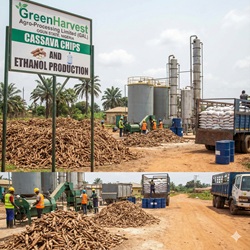
Agro-Processing Limited (GAL) is a proposed integrated cassava chips and
ethanol production company to be located in the agro-industrial belt of Ogun
State, Nigeria. The business aims to leverage the region’s abundant cassava
supply, growing industrial demand for ethanol, and increasing global shift
towards locally sourced agricultural raw materials. Nigeria is the world’s
largest producer of cassava, yet value-addition remains significantly
underdeveloped. GAL intends to fill this gap through a modern facility that
processes fresh cassava tubers into high-grade cassava chips and industrial
ethanol for food, beverage, pharmaceutical, chemical, and renewable-energy
markets.
The
business will operate a dual-production model:
- Cassava Chips Production: High-quality dried cassava
chips for export, animal feed manufacturers, ethanol plants, and starch
processors.
- Ethanol Production: Fuel-grade and
industrial-grade ethanol produced through fermentation and distillation of
cassava mash.
Ogun
State offers a strategic advantage with easy access to raw materials from local
farmers, close proximity to Lagos for large industrial off-takers, an expanding
agricultural processing cluster, and a supportive policy environment for
agro-industrial investments. The facility will incorporate automated drying
systems, stainless-steel fermentation tanks, continuous distillation units,
chip cutters, and waste-to-energy technology that converts cassava peels into
biogas.
A startup
capital requirement of ₦3.8 billion – ₦5.4 billion is projected to cover
land acquisition, factory construction, machinery procurement, working capital,
and licensing. With a proposed raw material requirement of 120–150 tons of cassava
per day, the plant is expected to produce approximately 30–40 tons of cassava
chips daily and 25,000–30,000 liters of ethanol per day.
Financial
projections show that the company will achieve profitability from the second
full year of operation, driven by high market demand, export opportunities, and
multiple revenue streams. The business model minimizes waste through full
utilization of cassava by-products, making the operation environmentally
sustainable and cost-efficient.
With a
strong management team, robust supply-chain partnerships, and scalable
production technology, GreenHarvest Agro-Processing Limited is positioned to
become one of the leading cassava processing and ethanol manufacturing firms in
Nigeria and an important contributor to Ogun State’s agro-industrial growth.
2.0 COMPANY DESCRIPTION
2.1 Company Name
GreenHarvest Agro-Processing Limited (GAL)
2.2 Registered Business
Address
GreenHarvest Agro-Processing Limited
KM 12, Ikenne–Sagamu Agro-Industrial Corridor,
Sagamu LGA, Ogun State, Nigeria.
This area is selected due to its proximity to cassava-producing communities
such as Ikenne, Ilisan, Ode-Remo, Isiwo, and the broader Remo–Ijebu axis.
2.3 Nature of Business
GreenHarvest Agro-Processing Limited is an integrated agro-processing and
renewable manufacturing company focused on:
1. Cassava Chips Production
o
High-quality dried cassava
chips
o
Export-grade chips for
Asian markets
o
Chips for animal feed
producers
o
Chips for domestic starch
processors and ethanol plants
2. Ethanol Production
o
Industrial-grade ethanol
(95–96%)
o
Fuel-grade ethanol (99.5%+)
through molecular sieves
o
Pharmaceutical and
cosmetic-grade ethanol
o
Beverage-grade ethanol
(under regulatory licensing)
3. By-Product Utilization
o
Cassava peels → biogas
o
Spent mash → high-quality
animal feed
o
Wastewater → treated for
reuse
o
CO₂ from fermentation →
captured for industrial supply
This integrated approach ensures GreenHarvest operates a zero-waste
production system, maximizing profitability and sustainability.
2.4 Vision Statement
“To become Nigeria’s leading integrated cassava chips and ethanol processing
company, known for quality, sustainability, innovation, and contribution to
national industrialization.”
2.5 Mission Statement
“To transform Nigeria’s cassava value chain through modern processing
technologies, strong partnerships with farmers, and production of globally
competitive cassava products and ethanol.”
2.6 Core Values
· Quality: Consistently
exceeding industry standards.
· Sustainability:
Minimizing waste and promoting renewable production.
· Innovation: Continuous
improvement in processes and technology.
· Integrity: Ethical
sourcing, fair business practices, transparency.
· Partnership: Strong
collaboration with farmers, distributors, and regulators.
2.7 Key Business Objectives
Short-Term (1–2 Years)
· Establish fully operational factory with installed capacity of 120–150
tons/day cassava processing.
· Achieve 30–40 tons/day of cassava chips
output.
· Achieve 25,000–30,000 liters/day of ethanol
production.
· Build a strong raw material supply network with 3,000+
local farmers.
· Secure supply contracts with Lagos-based industries:
pharmaceuticals, chemicals, breweries, and food processors.
Medium-Term (3–5 Years)
· Expand raw material intake to 200–250 tons/day.
· Add a second distillation column for higher purity ethanol.
· Begin ethanol export under
ECOWAS trade agreements.
· Establish GreenHarvest Research & Development
Center focusing on cassava varieties and process optimization.
· Grow annual revenue to ₦15–₦22 billion.
Long-Term (5–10 Years)
· Become the largest ethanol producer in West Africa.
· Deploy a franchise model for cassava chip aggregation across the
South-West.
· Expand plant capacity with automatic bagging, expanded storage
silos, and logistic fleet.
· List on the Nigeria Exchange Group (NGX).
Click “DOWNLOAD NOW” below to get the complete Business Plan
FOR QUICK HELP CHAT WITH US NOW!
+(234) 0814 780 1594



Login To Comment